
NEWS
Cornell Builds a Compact Gene Editor That Skips CRISPR
Cornell fused tiny TldR proteins to a transposon helper to paste large DNA in bacteria, a compact bet in a race already running in human cells.

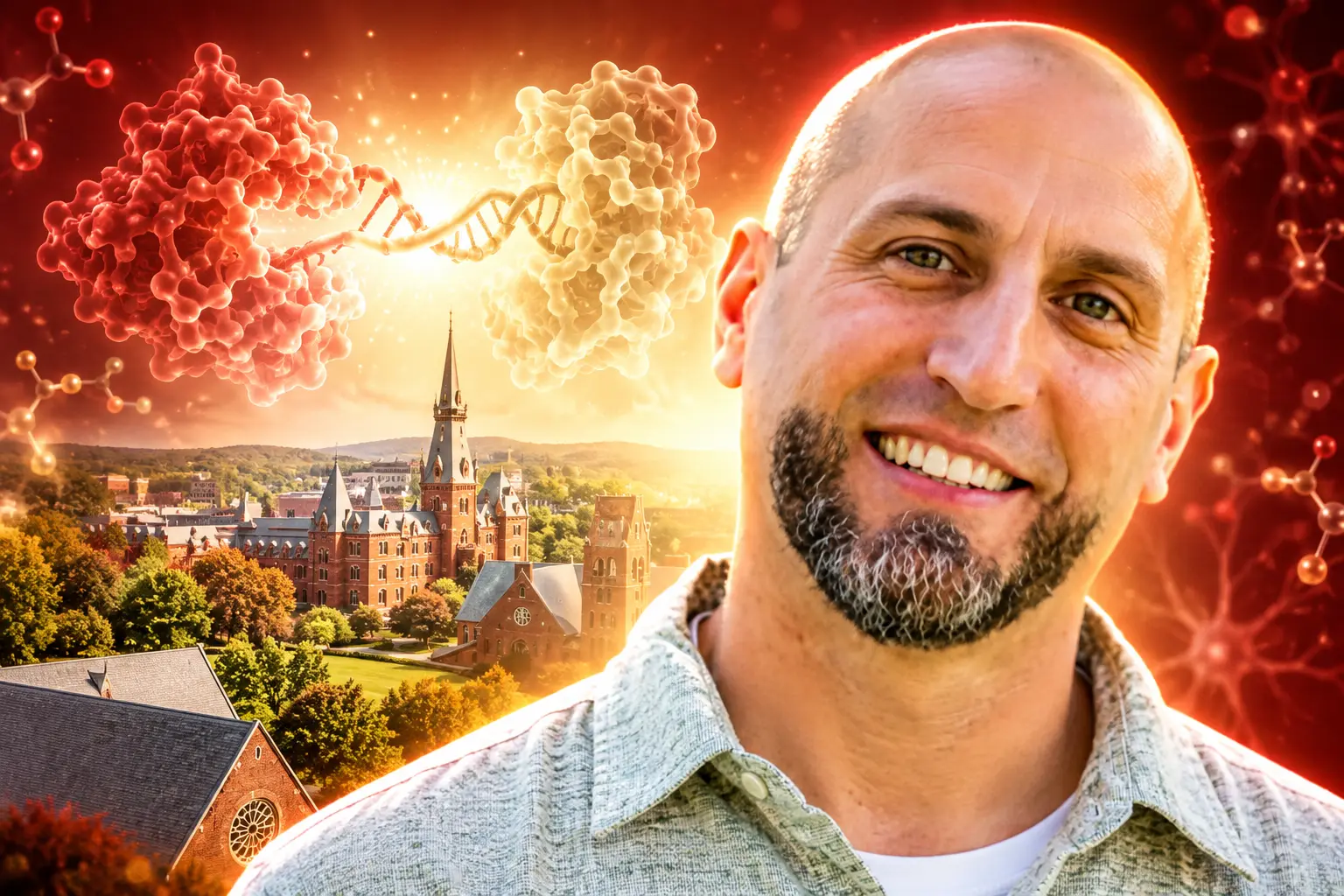
Cornell microbiologists fused two bacterial proteins that never meet in nature into a compact gene editor that pastes large DNA blocks at a chosen site in E. coli. The Oct. 1 paper in Molecular Cell describes an RNA-guided transposition system, not a treatment and not a test in human or plant cells.
Joseph Peters at Cornell microbiology led the study and said the field is already crowding around one job, delivering a big genetic payload. A separate CAST editor has already done that job in human cells.
Cornell Fuses Two Bacterial Proteins That Never Met
The new tool is not a CRISPR-Cas9 upgrade. The team joined TldR, an RNA-guided protein that finds a DNA address, to TniQ, which helps lock an insert in one orientation at that address. Those parts do not travel together in living bacteria. Peters said the group fused them on purpose to open designs that natural CRISPR transposons do not offer.
So, we took these vastly different kinds of components and we fused them together.
Joe Peters, professor of microbiology, College of Agriculture and Life Sciences
Co-first authors are former graduate student Richard Schargel, Ph.D. ’26, and graduate student Laura Chacon Machado, both in the Department of Microbiology. Co-authors include Shravanika Kumaran and Jordan E. Thesier at Cornell and Alba Guarné, professor of biochemistry at McGill University. The National Institutes of Health, the National Science Foundation, and the Canadian Institutes of Health Research funded the work. The university has applied for a patent on the RNA-guided transposition system.
The journal posted the article as online first in mid-September, then again on Oct. 2 as the issue moved. Cornell described the paper on Oct. 7.
De novo-engineered guide RNA-directed transposition with TnpB-family proteins dlvr.it/TVlPz7 pic.twitter.com/pfxLLMpQyL
— Molecular Cell (@MolecularCell) October 2, 2026
Why Smaller Editors Fit Inside a Virus
Peters’s second claim is about bulk. CRISPR-Cas systems are large, and the viruses used to ship editors have little spare room. Adeno-associated virus, a common gene-therapy shell, packages about 4.7 kb of DNA once promoters and other parts are counted. Cas9 proteins already eat most of that budget. A smaller editor leaves room for the payload and for the extra parts plant or human cells demand.
TldR proteins run about 300 to 350 amino acids. Typical TnpB proteins, their nuclease cousins, run about 400. Cas9 proteins sit in a band of about 1,000 to 1,600 amino acids. Peters put the design rule in one line: you want things that are smaller and with fewer components because it makes delivery easier.
Type V-K CAST systems, the compact CRISPR transposons this work starts from, still use four transposon-encoded proteins plus a host factor called S15. The engineered TldR system is built to run on three proteins: TnsB, TnsC, and the TniQ-TldR fusion. Dropping Cas12k and the host factor is the size cut that the campus story treated as a bonus. In the delivery traffic jam, it is the point of the fusion.
Human Cells Already Take Gene-Sized CAST Inserts
Large, precise inserts have been the hard problem in gene editing for years. Base editors change one DNA letter. Prime editors can rewrite a short stretch. Many diseases are not one-letter errors. They need a whole gene, or a long stretch of DNA, placed without a messy double-strand break.
CRISPR-associated transposases, or CASTs, do that job in bacteria. They use RNA to find a site and a transposase to drop in cargo without cutting the target in two. In 2019, Samuel Sternberg at Columbia and Feng Zhang at the Broad Institute independently laid out how those systems work. In human cells the natural enzymes barely moved. Sternberg’s lab measured editing in about 0.1 percent of cells.
On May 15, 2025, Sternberg and David Liu published programmable gene insertion in human cells with an evolved CAST they named evoCAST. After hundreds of rounds of phage-assisted evolution, the system reached about a 200-fold gain in activity and 10 to 30 percent integration of kilobase-size cargoes across 14 human genomic sites, including safe-harbor loci and genes tied to loss-of-function disease. Liu called the starting efficiency a hundred-fold below a useful therapy bar.
This was a swing-for-the-fences project in that we started with a really complicated system that had a hundred-fold lower efficiency than would be therapeutically useful.
David Liu, Richard Merkin Professor, Broad Institute
Peters is not pretending the Cornell fusion is that mammalian result. He said there is a huge amount of competition focused on delivering a big payload. The Molecular Cell paper is one more targeting module in that contest, still in bacteria, while evoCAST is already past the human-cell gate.
HOW THE INSERT TOOLS COMPARE
| System | Targeting protein | Shown in | What it installs |
|---|---|---|---|
| CRISPR-Cas9 | Cas9 (about 1,000 to 1,600 aa) | Many species | Cuts DNA; small edits, with break damage |
| Base / prime editing | Cas nickase plus extra enzymes | Many species | One letter, or a short rewrite |
| Type V-K CAST (ShCAST) | Cas12k plus TniQ, TnsB, TnsC, host S15 | Bacteria; tiny activity in human cells | Large cargo, no target double-strand break |
| evoCAST (2025) | Evolved CAST stack | Human cells, 14 sites | Kilobase cargoes at 10 to 30 percent |
| Cornell TldR-TniQ fusion | TldR (300 to 350 aa) fused to TniQ | E. coli only | Large, one-way inserts; three proteins |
The table is the race Peters named, not a scoreboard with a winner. Cornell’s row is empty in the human-cell column on purpose.
What the E. coli Tests Measured
The starting chassis was ShCAST from the cyanobacterium Scytonema hofmannii, a type V-K system with a lot of structural maps already in the literature. Instead of Cas12k, the team fused ShCAST’s TniQ to TldRs from two branches. One, Efa1, comes from Enterococcus faecalis. The other, Eho, comes from Enterobacter hormaechei. Those branches use different TAM motifs, the short DNA flags that play the role a PAM plays in CRISPR.
TniQ-TldR fusions in E. coli placed inserts on site at rates that rival the natural Cas12k system. The Efa1 fusion reached about 58 percent on-site insertion. The Eho fusion reached about 83 percent. ShCas12k itself was about 79 percent on target in the same comparison. Inserts went in one orientation. A 20-nucleotide guide gave the best mix of frequency and precision; shorter matches, enough for TldR to repress a gene in older assays, were weaker when the job was transposition.
E. COLI ON-SITE INSERTION
| Targeting module | On-site insertion |
|---|---|
| ShTniQ-Efa1 TldR fusion | About 58 percent |
| ShTniQ-Eho TldR fusion | About 83 percent |
| Natural ShCas12k (same tests) | About 79 percent |
The team also tested other TnpB-family proteins in the same TniQ fusion, including prototypical TnpB nucleases and Fanzors, the eukaryotic TnpB homologs that look like the easy bridge into plant and animal cells. Only the TldR fusions gave robust, programmable transposition. That result cuts against the simple hope that a eukaryotic cousin would be the first protein to carry this tool out of bacteria.
A second, related set of experiments stayed with Cas12k CAST and mutated the TniQ-TnsC interface. Those changes cut effector-independent off-site inserts and raised on-site activity, a separate fix for a known V-K CAST flaw. Native V-K systems also copy themselves as they move, which can drag plasmid backbone into the target. The paper shows the TldR fusions can be paired with an exonuclease domain so the move is cut-and-paste instead of that replicative path.
Peters Has Chased Jumping Genes for Decades
Peters is a transposon biologist, not a CRISPR celebrity. In 2017 he showed that some Tn7-like jumping genes had co-opted CRISPR-Cas systems, not to cut viruses but to choose where they land. That observation is why CAST exists as a research field.
FROM JUMPING GENES TO A FUSION EDITOR
- 2017: Peters reports that some transposons carry CRISPR-Cas and use it to pick insertion sites.
- 2019: Sternberg and Zhang groups characterize CAST systems that insert cargo under RNA guide control.
- July 15, 2021: A Cornell cryo-EM paper with Elizabeth Kellogg and Ailong Ke maps how the CAST regulator TnsC picks a target, work Peters said was needed before anyone could engineer the system for other cells.
- 2024: TldRs are described as RNA-guided repressors, TnpB proteins that lost their nuclease and now silence genes.
- May 15, 2025: evoCAST reaches 10 to 30 percent gene-sized inserts in human cells.
- Aug. 27, 2025: The Cornell TldR-TniQ preprint posts on bioRxiv.
- Oct. 1, 2026: Molecular Cell publishes the engineered fusion.
Ke, a Cornell colleague, had already named the delivery jam in 2022, when his lab mapped IscB, a compact Cas9 ancestor. Next-generation editors need extra enzymes fused on, and most Cas9s are already too big for a single viral ride. The TldR fusion is Peters answering that jam from the transposon side, with a DNA-binding protein that never was a CRISPR effector.
The Unused TldR Family Is the Open Design Space
TldRs were not invented for editing. A 2024 study described them as nuclease-dead TldR transcription factors, TnpB proteins that bacteria and phages had already converted into programmable repressors. They are smaller than TnpB because catalytic stretches are gone. They bind DNA with a guide RNA. They do not cut.
That is why they were a clean swap for Cas12k, which in type V-K CAST is itself a nuclease-dead Cas12 that only points the transposase. The Cornell paper treats the wider TnpB superfamily as a parts bin. TldRs are one subgroup. Peters said the lab is screening related proteins for versions that might work in human or plant cells. Access to that family, not a single hero enzyme, is the design claim.
WHAT THE FUSION CHANGES
- No Cas12k: A TldR protein finds the site, so the CRISPR effector is gone from the stack.
- No S15 host factor: The engineered path drops a bacterial helper that type V-K CAST needs.
- Three proteins: TnsB, TnsC, and the TniQ-TldR fusion carry the insert job.
- One orientation: Cargo goes in a single direction, which simplifies later engineering.
- A 20-base guide: Full-length complementarity raised both yield and on-target precision in E. coli.
Fanzors remain interesting for a different reason. They already live in eukaryotic genomes and are small. They just did not, in this fusion, drive transposition the way TldRs did. If a later TldR relative works in a plant nucleus, that screen is what will have found it, not the E. coli paper on its own.
Plant and Human Versions Remain Unproven
The Cornell release is careful in one place and loose in another. It states the system was proven in bacteria. It also holds out plants, animals, and people. Those are hopes the group is testing, not results in the paper. Extra nuclear-localization tags, codon changes, and other add-ons will be needed before a bacterial transposon stack runs in a plant or human cell. Peters said the smaller system leaves room for those add-ons. Whether it can be delivered safely, or place DNA accurately, in other organisms has not been shown.
You can program it to put in a huge block of DNA in a new location, Peters said, and that has the field excited. The excitement is real and already populated. evoCAST, prime-editor recombinase methods, and bridge recombinases are all aimed at the same paragraph-length rewrite. Cornell’s contribution is a CRISPR-free targeting protein that is small, modular, and still sitting in E. coli with a patent application behind it.
The next result that would move this story is a TldR-family protein that works in a plant or human cell, with the insert still landing in one orientation at the programmed site. Until that assay exists, the Molecular Cell paper is a bacterial design study with a delivery argument attached, and that is a stronger claim than a new CRISPR for the clinic.
Disclaimer: This article is news reporting on laboratory research and is for information only. It is not medical advice, a diagnosis, or guidance to seek, avoid, or enroll in any gene-editing procedure or trial. Readers who have questions about a genetic condition or an experimental therapy should speak with a licensed physician or a clinical genetic counselor before making health decisions. Protein sizes, insertion rates, and study claims reflect the cited papers and university statements on the dates given and may change as the work is repeated in other cells.

Cornell Builds a Compact Gene Editor That Skips CRISPR

FKA Twigs Forces Shia LaBeouf to Void Their NDA

United Returns to Flagstaff After an $800,000 Grant

Reflection’s Beam Offers a Western Open-Weight Workhorse

VSS Hires a World Bank Adviser to Run Portfolio AI

Bravo Cuts Nathan Gallagher but Still Airs Below Deck

Apple Uses a Returned MacBook to Press OpenAI Hardware

Google AI Mode Adds Paginated Follow-Ups With Skip

U2 Puts Carnaval de Luz After a Year of Ashes

Goldman’s $1.2 Trillion AI Capex Needs $300 Billion in Revenue
-
 ENTERTAINMENT1 month ago
Bravo Cuts Nathan Gallagher but Still Airs Below Deck
-
 NEWS1 month ago
Apple Uses a Returned MacBook to Press OpenAI Hardware
-
 NEWS1 month ago
Google AI Mode Adds Paginated Follow-Ups With Skip
-
 ENTERTAINMENT2 weeks ago
U2 Puts Carnaval de Luz After a Year of Ashes
-

 NEWS1 month ago
Australia’s Teen Social Media Ban Still Lets Most Kids In
-
 NEWS2 weeks ago
Goldman’s $1.2 Trillion AI Capex Needs $300 Billion in Revenue
-

 GAMING4 weeks ago
Dawnwalker Hits 1 Million as Players Stretch Its Clock
-

 ENTERTAINMENT2 weeks ago
Hans Zimmer Takes the Next Level Across 30 Arenas