
BUSINESS
Senate Blocks the CLARITY Act and Hands Crypto to Agencies
The CLARITY Act failed 49-50, so U.S. crypto rules stay with a March SEC-CFTC memo that either agency can cancel on 30 days’ notice.

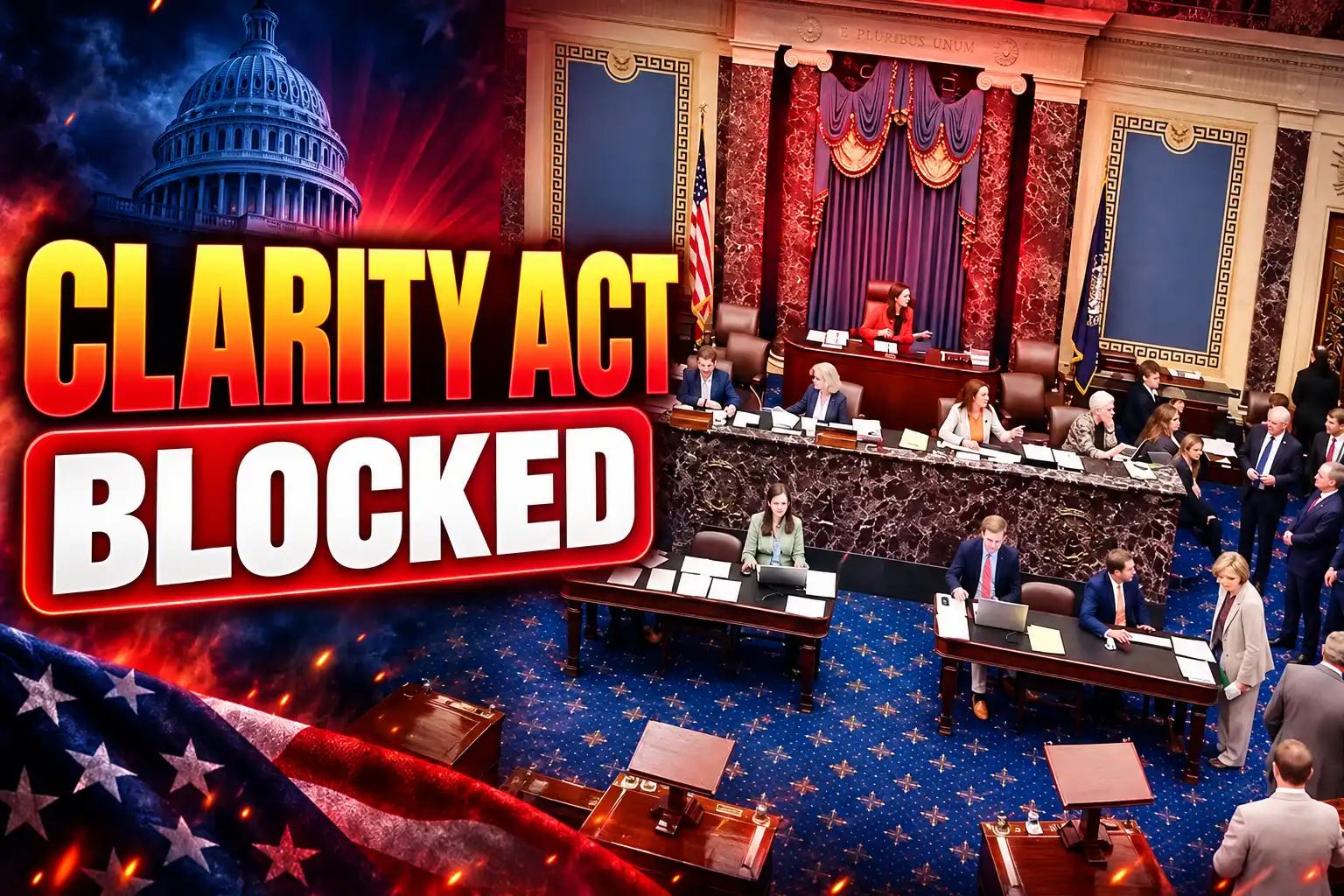
The Senate rejected cloture on the CLARITY Act 49-50 on Sept. 15, 11 votes short of the 60 required to even begin debate. Bitcoin slipped below $76,000 as traders marked down a bill that never reached the floor.
The vote does not pause U.S. crypto policy. It leaves the rulebook with Paul Atkins at the SEC and Michael Selig at the CFTC, whose March memo can be ended on 30 days’ notice.
A 49-50 Cloture Never Opened the Bill
Tuesday’s question was not passage. It was cloture on the motion to proceed to H.R. 3633, the Digital Asset Market Clarity Act, recorded as roll call 234. A yes would only have opened debate, amendments, and a later passage vote. The no means that debate never starts.
Voting began at 2:18 p.m. The clerk posted the result at 3:00 p.m.: 49 yeas, 50 nays, one senator not voting. Sixty votes were required. The 49-50 cloture roll call shows every yea came from a Republican.
Chris Coons, Democrat of Delaware, did not vote. Independents Angus King of Maine and Bernie Sanders of Vermont voted no, as did 44 Democrats. Republicans hold 53 seats. Four of them voted no, which is how the yes column stopped at 49.
THE AFTERNOON THE BILL STALLED
- 10:07 a.m.: Majority Leader John Thune speaks on crypto as the Senate opens.
- 1:50 p.m.: After the caucus lunch, Elizabeth Warren takes the floor on crypto and President Donald Trump.
- 2:09 p.m.: Cynthia Lummis of Wyoming speaks for the bill she has shepherded since 2022.
- 2:18 p.m.: Cloture voting begins on the motion to proceed to H.R. 3633.
- 3:00 p.m.: The chair announces 49-50, with Coons not voting and Collins, Hawley, Moran, and Tillis recorded as no.
- 3:01 p.m.: Thom Tillis enters a motion to reconsider H.R. 3633, then the chamber moves on to a college-sports bill.
The House had already passed the measure 294-134 in July 2025. The Senate Banking Committee had advanced a version 15-9 in May, with some Democratic support that did not survive the floor. Majority Leader John Thune can still call the bill back. Calendar No. 423 is not formally dead. The arithmetic that failed on Tuesday does not get easier in a midterm month.
126 Democratic Asks Still Produced Zero Yes Votes
Sponsors spent the weekend loading the text with ethics language Trump had resisted, including a requirement that federal officials and their spouses divest large crypto holdings or put them in a blind trust, plus a role for state attorneys general. Coinbase chief policy officer Faryar Shirzad wrote that the final draft folded in 126 additional changes Democrats had requested, on top of seven market-structure pillars a group of Democratic senators had published a year earlier.
Lummis put the same offer on the record the night before the vote. She said Trump had accepted ethics limits on federally elected officials, judges, and their spouses, and that a no vote would leave Americans with no statutory protections in digital-asset markets.
After a year of intense daily bipartisan negotiations, this bill is ready. Here is the final text. President Trump voluntarily agreed to new ethics provisions holding every federally elected official, judge, and their spouses to some of the toughest ethics restrictions in U.S.…
— Senator Cynthia Lummis (@SenLummis) September 14, 2026
It still produced zero Democratic yeas. Kirsten Gillibrand of New York, long treated in the industry as a possible crossover, voted no. Ruben Gallego of Arizona, who had been in the ethics talks, voted no. Warren, the bill’s most public opponent, had already told the chamber it failed to protect investors, the financial system, and national security, and she spent her floor time on Trump’s crypto ventures.
Fails to adequately protect investors, our financial system and our national security.
Elizabeth Warren, U.S. senator from Massachusetts, on the Senate floor
Mark Warner of Virginia said the Senate could not pass a law that lets a sitting president profit personally. Michael Bennet of Colorado said the text did not rein in what he called the president’s crypto ventures. Elissa Slotkin of Michigan called the ethics clauses too thin and said money-laundering safeguards and CFTC staffing were still unfinished. Trump’s 2025 financial disclosures show more than $1.4 billion in crypto-related income, including from World Liberty Financial and the $TRUMP meme coin. That figure, not the token taxonomy, is what Democratic leadership chose to fight on.
Hawley and Moran Drew the Line at Bank Deposits
The ethics fight explains the Democratic caucus. It does not, by itself, explain the four Republican nays. Susan Collins of Maine, Josh Hawley of Missouri, and Jerry Moran of Kansas voted no on the merits. Tillis voted no so he could move to reconsider. On substance, the Republican conference was 50 in favor and three against, and even a clean 53-0 would have left the bill seven votes short of 60.
THE FOUR REPUBLICAN NAYS
| Senator | State | How the floor log records it |
|---|---|---|
| Susan Collins | Maine | Nay on the merits |
| Josh Hawley | Missouri | Nay on the merits |
| Jerry Moran | Kansas | Nay on the merits |
| Thom Tillis | North Carolina | Nay to enter a motion to reconsider |
Hawley and Moran have treated community-bank deposits as a home-state issue for months, arguing that stablecoin rewards on crypto platforms can pull cash out of small banks that fund farms and Main Street loans. The last Republican draft tried to blunt that fear by letting the Treasury secretary restrict those yields if community banks saw widespread deposit flight within 18 months of enactment. It was not enough for the two of them.
Collins has kept her distance from Trump for years and did not issue a detailed floor explanation in the press log. The banking fight is the piece the ethics coverage buried. A 600-plus-page market-structure bill died in part because Missouri and Kansas still did not trust the yield language, and because Democrats would not take a blind-trust option in place of forced divestment.
Why Tillis Switched After the Result Was In
Tillis had backed the ethics package that morning. He then changed his vote to no once it was clear cloture would fail, a familiar Senate device: only a senator on the prevailing side can move to reconsider. He entered that motion at 3:01 p.m. and said the White House’s work was not wasted.
This is not the end for the Clarity Act. We’ve made substantial bipartisan progress in large part because of the White House. This procedural motion allows us to continue working towards a positive outcome.
Thom Tillis, U.S. senator from North Carolina, on X
Lummis did not share that patience. She told reporters, “I think we’re done. It’s over,” then went further online, accusing Democrats of standing with illicit finance and against workers. Ripple called the result a tremendous missed opportunity for consumers, the industry, and U.S. competitiveness, while stressing that XRP’s legal footing did not depend on this bill. Brad Garlinghouse, Ripple’s chief executive, wrote that the loss stung and that the industry needed a serious review of why the votes were not there.
Tillis kept a procedural door cracked. Lummis described a political one that had shut. Both can be true at once. A motion to reconsider does not create 11 Democratic votes, and it does not add floor days the calendar has already taken away.
Oct. 5 Starts a Month Away From the Floor
The Senate’s 2026 legislative schedule lists a state work period from Oct. 5 through Nov. 6. Election Day is Nov. 3, inside that break. Sept. 21 is already marked as a non-legislative day. House members are due out of Washington before the Senate, with that chamber wrapping its week and heading home to campaign.
THE DAYS STILL ON THE CLOCK
- Sept. 21: Senate non-legislative day, already on the posted calendar.
- Oct. 5: State work period begins; the chamber is not in session through Nov. 6.
- Nov. 3: Midterm Election Day, while senators are still in that work period.
Members in tight races want to be at home, not in a 60-vote grind on a 600-plus-page crypto bill. Prediction-market traders on Polymarket cut the odds of the bill becoming law this year to 6.5% from 29.5% on Monday. Galaxy Research had already slashed 2026 passage odds from 75% in May to about 10% by mid-August. The floor vote confirmed that slide. A new Congress in January 2027 resets the calendar, the committee ratios, and the set of people Lummis has to reassemble.
Atkins and Selig Keep a Revocable Rulebook
The industry’s own executives had already described the backup plan. Before the vote, Coinbase chief executive Brian Armstrong said that if the bill failed, the SEC and CFTC were ready to publish rulemaking, so the market would get regulatory lines either way. That is now the live path, and it is faster than a statute. It is also weaker.
Atkins and Selig signed a March 11 coordination memorandum on harmonizing crypto products, dual registrants, and exams. The document says it does not create legally binding obligations. Either party may end it on 30 days’ written notice. On March 17 they issued a joint reading that sorts tokens into five buckets and states that most crypto assets trading today are not, by themselves, securities.
THE FIVE TOKEN BUCKETS FROM MARCH
- Digital commodities: Tokens tied to a working network’s operation, read as outside securities law and overseen more like CFTC commodities, including bitcoin and ether in the agencies’ examples.
- Digital collectibles: NFTs and similar one-off items, treated as outside securities law in the joint reading.
- Digital tools: Access or utility tokens whose main job is a function inside a protocol, also read as outside securities law.
- Payment stablecoins: Conditionally outside securities law, with qualifying payment stablecoins already handled in statute by the GENIUS Act.
- Digital securities: The bucket where federal securities law still applies.
The SEC’s remaining agenda, as Atkins has described it, includes registration exemptions for token launches, a safe harbor for projects that decentralize, and rules on custody and trading venues. Selig has directed CFTC staff to say when non-custodial software developers must register, how leveraged retail crypto trades should be treated, and how to classify crypto perpetuals. That work now speeds up because Congress did not take the wheel.
This MOU does not supersede any applicable laws or regulations nor does it create any legally binding obligations.
SEC and CFTC, Memorandum of Understanding, March 11, 2026
A later chair can rewrite the five buckets, scrap the safe harbor, or send the 30-day notice and walk away. That is the instability a statute was designed to end. Agency lines can still harden in practice if trading venues, banks, and developers build on them. They cannot bind the next administration the way H.R. 3633 would have. The GENIUS Act’s payment-stablecoin rules remain on the books, so one slice of the market already has a law. Spot trading, token launches, and DeFi do not.
Spot Bitcoin ETFs Shed $450.33 Million on Tuesday
Bitcoin’s print was the headline. It was not the sharpest move. The token held the area below $76,000 after an already-soft week, with oil near $103 a barrel and a Federal Reserve decision on the same calendar. U.S. listed crypto stocks took the direct hit, which is what a market does when it pulls a Washington premium out of exchange shares rather than out of the asset itself.
TUESDAY’S REGULATORY TAPE
| Market | Tuesday print |
|---|---|
| Bitcoin | Below $76,000 |
| U.S. spot bitcoin ETFs (SoSoValue) | $450.33 million outflow, heaviest since June 25 |
| Coinbase | Closed 10% lower |
| Circle | Fell 11% |
| Strategy | Declined 5% |
SoSoValue’s $450.33 million ETF outflow is the cleanest single figure attached to the session, and it landed on the same day as the cloture board. Coinbase, Circle, and Strategy are the firms that needed a statute for listing, custody, and treasury policy. They repriced first. Bitcoin, which the March joint reading already treats as a digital commodity, had less statutory news to digest.
That split is the tell. Traders did not abandon the asset class. They marked down the companies that had paid for a law, then watched Atkins and Selig keep the pencil. A memo that dies on 30 days’ notice is now the working U.S. rulebook, because 60 senators would not pick up the 600-page alternative.
Disclaimer: This article is news reporting and analysis of a Senate vote, related agency documents, and market prints. It is informational only and is not investment advice, tax advice, legal advice, or a recommendation to buy, sell, or hold bitcoin, any other digital asset, or any stock. Readers should consult a licensed financial adviser, and where a business or trading question turns on U.S. securities or commodities rules a qualified securities lawyer, before acting on anything described here. Vote tallies, prices, and agency texts reflect the public records cited in this report and can change.

U2 Puts Carnaval de Luz After a Year of Ashes

Hans Zimmer Takes the Next Level Across 30 Arenas

Goldman’s $1.2 Trillion AI Capex Needs $300 Billion in Revenue

Diesel Hits a Record as U.S. Gas Prices Climb

Medicare’s WISeR Pilot Pays Vendors to Stop Care

Bravo Cuts Nathan Gallagher but Still Airs Below Deck

Apple Uses a Returned MacBook to Press OpenAI Hardware

Google AI Mode Adds Paginated Follow-Ups With Skip
U2 Puts Carnaval de Luz After a Year of Ashes
Goldman’s $1.2 Trillion AI Capex Needs $300 Billion in Revenue
-
 ENTERTAINMENT4 weeks ago
Bravo Cuts Nathan Gallagher but Still Airs Below Deck
-
 NEWS1 month ago
Apple Uses a Returned MacBook to Press OpenAI Hardware
-
 NEWS4 weeks ago
Google AI Mode Adds Paginated Follow-Ups With Skip
-
 ENTERTAINMENT6 days ago
U2 Puts Carnaval de Luz After a Year of Ashes
-
 NEWS6 days ago
Goldman’s $1.2 Trillion AI Capex Needs $300 Billion in Revenue
-

 GAMING3 weeks ago
Dawnwalker Hits 1 Million as Players Stretch Its Clock
-
 ENTERTAINMENT6 days ago
Hans Zimmer Takes the Next Level Across 30 Arenas
-

 NEWS3 weeks ago
Australia’s Teen Social Media Ban Still Lets Most Kids In