
NEWS
Goldman’s $1.2 Trillion AI Capex Needs $300 Billion in Revenue
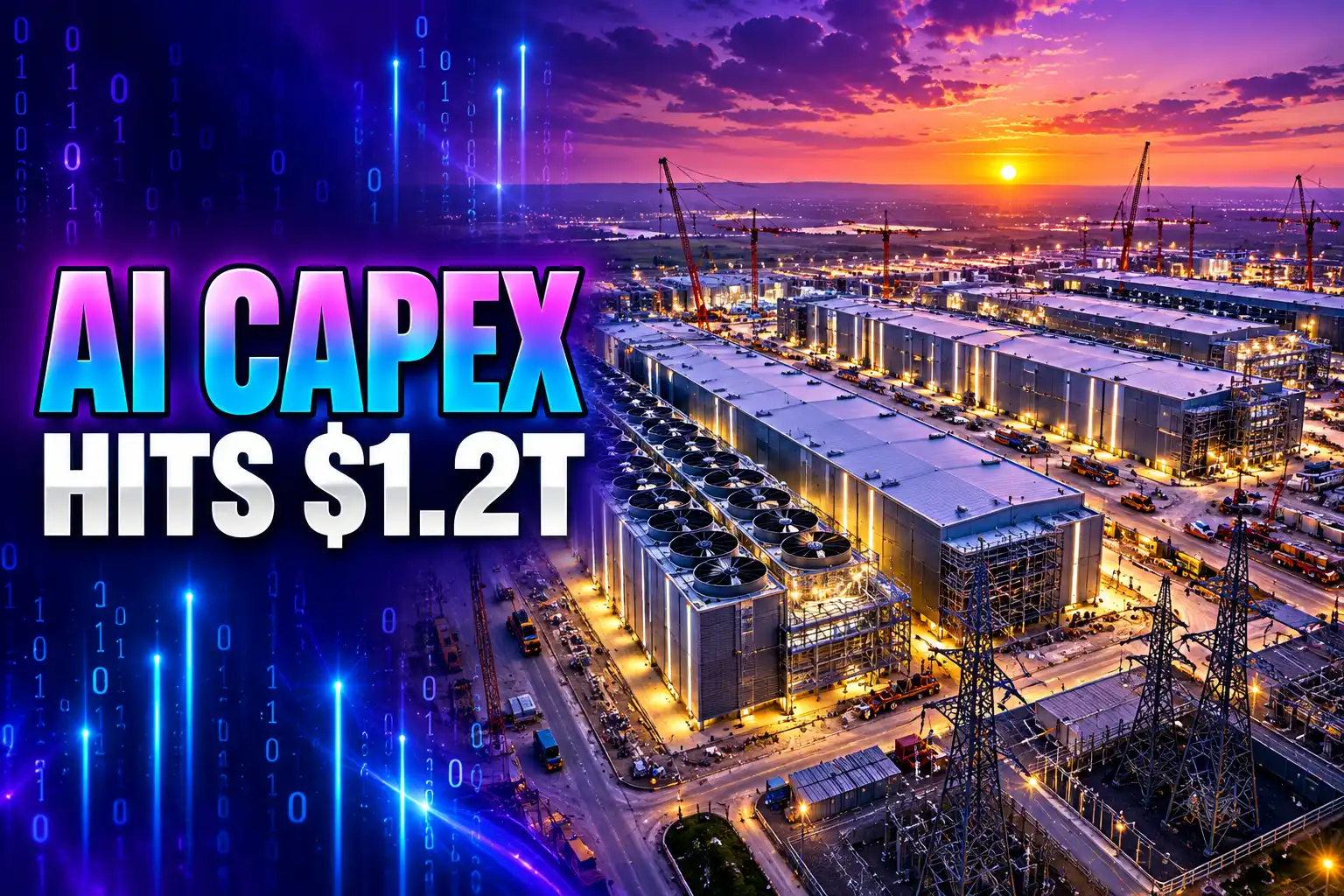
Goldman Sachs raised 2027 hyperscaler AI capex to $1.2 trillion, above consensus, and said the five firms need about $300 billion a year to break even.

Goldman Sachs now puts 2027 AI infrastructure spending by Amazon, Alphabet, Microsoft, Oracle and Meta at $1.2 trillion. That is $100 billion above the Wall Street consensus, and up from $800 billion this year.
The same forecast says the five hyperscalers need about $300 billion a year in AI revenue just to break even. Bond desks and unsigned leases are already carrying a growing share of the bill.
Goldman Puts 2027 Hyperscaler Capex at $1.2 Trillion
Strategists led by Ryan Hammond raised the 2027 print on Sept. 25 and left it above the Street’s $1.1 trillion. The bank’s own equity desk had already put the same dollars on paper two days earlier. Ben Snider, chief U.S. equity strategist at Goldman Sachs Research, wrote that the largest U.S. hyperscalers are on track for $800 billion of capital spending this year, an increase of 94% over 2025, then almost half of S&P 500 earnings growth in 2026 from the AI build, with $1.2 trillion of hyperscaler capex in 2027 and $1.4 trillion in 2028.
Hammond’s team described the 2027 step as a 54% jump, then a 12% increase in 2028 that takes the total to $1.4 trillion. The dollar line is still rising. The growth rate is not. This year’s 94% surge cools to 54%, then to 12%.
THE 2026 TO 2028 SPEND PATH
| Tally | 2026 | 2027 | 2028 |
|---|---|---|---|
| Goldman Sachs Research | $800 billion | $1.2 trillion | $1.4 trillion |
| Wall Street consensus | – | $1.1 trillion | – |
| Jamie Dimon, Sept. 21 | $700 billion | $1 trillion | – |
JPMorganChase chairman and CEO Jamie Dimon, speaking on Sept. 21, used a lower path: $300 billion last year, $700 billion this year, $1 trillion next year. “That’s like a 1% increase to GDP each year and obviously it may add a little bit to inflation because you’re hiring people, you’re building factories, you’re buying equipment and copper wires, and building powerplants and all of that,” he said. “But it’s an unbelievable technology, so down the road it could very well enhance deflationary factors out there.”
A wider net already sits above Goldman’s five-name total. S&P Global Ratings, in an Aug. 27 report that adds SpaceX to Alphabet, Amazon, Microsoft, Meta and Oracle, said combined capex is projected to exceed $1.3 trillion by 2027.
The climb did not start this summer. Wharton finance professor Jessica Wachter and Jonathan Wachter, in five firms spent $226 billion in 2024 on plant and equipment, up 51% from $150 billion in 2023, after a flat $155 billion in 2022. Management forecasts collected for that paper already pointed to a 2026 total near three-quarters of a trillion dollars before Goldman marked this year at $800 billion.
The $300 Billion Break-Even Inside the Forecast
Buried in the Hammond note is the figure that prices the build. To break even on the outlays, Goldman said, the companies would need annual AI revenues of about $300 billion in the coming years. That is a quarter of next year’s $1.2 trillion spend, due every year, not once.
The hurdle moves with the write-off. Chips and servers that are written off in three years throw a much larger annual charge than the same kit stretched over six. A longer life cuts the revenue needed to cover depreciation. A shorter life raises it. Goldman did not publish the useful-life assumption behind the $300 billion, so the number is a floor that can travel.
a larger share of GDP than any technological investment cycle since the railroad build-out in the late 1800s
Ryan Hammond, Goldman Sachs strategist, Sept. 25 research note
Historical share-of-GDP work circulating with Goldman’s earlier notes puts U.S. railroad investment in the 1880s at 3.4% of GDP, electric motors in the 1920s at 2.2%, auto infrastructure in the 1910s at 2.1%, and 1990s telecom at 1.6%. Hyperscaler capex is put at about 2.4% of GDP in 2026 and 2.8% in 2027, which is the largest technology-investment share since the railroad era, not a print that tops the railroad peak. Bull cases of $1.1 trillion to $1.4 trillion would push the ratio above 4% of GDP and alongside those railroad booms.
Hammond’s team also flagged rising financing needs and physical limits (power, memory, labor, data-center construction) as reasons future spending growth could slow. The $1.2 trillion is a spending forecast. It is not a guarantee that every dollar turns into working compute on the same calendar.
When Capex Outran the Cash
Until this cycle, these firms funded data centers from operations. That arithmetic has broken. Isabel Juniewicz at Epoch AI, parsing SEC cash-flow tags for the same five companies, found cash capex growing about 70% a year against operating cash flow growing about 23%. On those trends, aggregate free cash flow hits zero around the third quarter of 2026.
THE CASH-FLOW CROSSOVER
- Capex growth: About 70% a year across Microsoft, Amazon, Alphabet, Meta and Oracle, from SEC cash filings.
- Operating cash growth: About 23% a year, so the two lines cross even while the firms stay profitable on an earnings basis.
- Company timing: Oracle had already crossed by June 16; Amazon was crossing then; Alphabet around 2027 Q1; Meta around 2027 Q3; Microsoft around 2028 Q3.
- Still in the black: All five remain profitable. Cash leaves the door up front; depreciation hits the income statement later.
Epoch’s chart of cash capex overtaking operating cash flow is a trend fit, not a full forecast of AI returns. If the new plants throw off cash faster than the last three years imply, the crossover slides. If they do not, the next dollar of spend has to come from cash piles, new equity, or debt.
Alphabet already printed the first negative free-cash-flow quarter since its 2004 IPO, in the second quarter of 2026. S&P Global Ratings expects all six of the names in its wider hyperscaler set to show negative free operating cash flow through 2027, with recovery not projected until 2029. The rating firm’s models assume a 2028 inflection, with revenues accelerating and capex growth slowing as the plants start to earn.
Union Bancaire Privée, in a Sept. 16 fixed-income note, put Microsoft as the only one of the five still funding the build from internal cash, and about a year behind the others. Oracle’s free cash flow was minus $24 billion in fiscal 2026. The four highest-rated names (Microsoft at AAA, Alphabet AA+, Amazon AA, Meta AA-) still have room. UBP estimates they could add about $400 billion of debt over the next 18 months and stay inside S&P’s downgrade lines. Oracle, at BBB-, does not sit in that group.
A Third of 2027 Capex Is Borrowed
Goldman credit strategists led by Amanda Lynam said in late July that debt is taking a rising share of the build. Investment-grade bond issuance from the five was $108 billion in 2025, about 26% of capex. They had already issued $194 billion in the first half of 2026, tracking toward about $250 billion for the full year, or about 33% of capex. For 2027, Lynam’s team expected about $400 billion of global IG issuance against an estimated $1.14 trillion capex bill, a share of about 35%.
“While the exact magnitude and mix of future debt issuance from the hyperscalers is uncertain, our review of management commentary leaves us expecting a growing role for debt financing in the AI buildout in the years ahead,” Lynam’s team wrote.
That $400 billion is only the on-balance-sheet paper. Meta’s El Paso campus with BlackRock is the other template: Meta put in more than $10 billion, BlackRock holds 80%, and part of that stake is funded with $12.5 billion of debt sitting in the venture, not on Meta’s parent line. UBP maps the same pattern at Meta’s Louisiana site with Blue Owl. Chip makers have joined as financiers. Nvidia has a platform meant to mobilize more than $500 billion of third-party capital with residual-value support. Broadcom stands behind as much as $29 billion of notes tied to TPUs leased to Anthropic.
Lotfi Karoui at PIMCO wrote on Sept. 14 that credit investors finance the AI buildout without taking much of the equity upside, so the question is whether spreads pay for obsolescence, re-contracting and refinancing risk. AI-related debt had underperformed broader indices in the quarter to date, on Bloomberg index data cited in that note. In a bust, Karoui argued, hyperscaler credit can even improve if capex is cut fast enough for free cash flow to recover. The catch is stickiness: power contracts, leases and chip orders can keep spending high after the growth rate has already rolled over.
UBP counts six names (the five plus Nvidia) at 4.6% of the U.S. investment-grade index, and about 8.0% if the screen is widened to everything the market now labels AI. More than half of the 2026 bonds from Oracle, Meta, Amazon and Alphabet were trading at least 5 basis points wider than issue as of Sept. 3, even as the rest of IG sat near post-crisis tights. The limit is less the ratings than the bid.
Signed Leases Still Sit Off the Balance Sheet
Reported debt at the five is about $566 billion, against about $614 billion of cash and securities, UBP said. Microsoft’s $46 billion of bonds is the smallest load of any company its size. Amazon owes $176 billion, Oracle and Alphabet about $130 billion each, Meta $84 billion. Add leases that have already started and the group splits: Microsoft, Alphabet and Meta below 1 times EBITDA on UBP’s gross measure, Amazon at 1.4 times, Oracle at 4.3 times.
The larger stack has not started yet. A lease on a hall still being built sits off the balance sheet until the building is ready. The undiscounted future payments UBP pulled from filings:
LEASES SIGNED, NOT YET STARTED
- Meta: $347 billion, commencing between 2026 and 2036, terms of up to 30 years.
- Microsoft: $329 billion of contracted payments waiting on completion.
- Oracle: $260 billion, consistent with a model that leases almost all of its sites.
- Amazon: $137 billion.
- Alphabet: $91 billion, the smallest unsigned book, because it owns more of its plants.
That is $1.16 trillion of non-cancellable payments. UBP notes the agencies do not treat these as debt until the halls open, which is why leverage can look light now and still rise in 2027 and 2028 even if no new contract is signed. Purchase commitments for chips, power and construction sit in a separate pile. The four largest cloud providers (excluding Meta) carried $2.3 trillion of contracted future revenue on their latest filings, up from $2.1 trillion three months earlier. Roughly 40% is owed by OpenAI and Anthropic. Those two labs have committed more than $1.25 trillion to compute between them, UBP estimates. Anthropic has turned an operating profit on $65 billion of annualized revenue. OpenAI is expected to burn more than $200 billion in cash through 2029.
Moody’s has called the result “a more circular system that could mask true demand.” Microsoft invests in OpenAI and sells it cloud. Amazon is a large investor in Anthropic and its primary cloud provider. Nvidia and AMD take equity in the labs that commit to their hardware. What enters the circle from outside is the bond market’s money, and later the customers’.
Power is the other clock. UBP cites 130 to 140 gigawatts of data-center capacity to be added in North America by the end of the decade, against U.S. electricity demand just shy of 500 gigawatts. About 60% of the fully loaded cost of a new leading-edge site is silicon and servers. Building spend, on UBP’s split, should double from $280 billion this year to about $590 billion in 2028 and then stop growing, while GPU and custom-chip spend rises from $340 billion to more than $800 billion by 2030. A building can carry a 20-year lease. A chip cannot.
S&P Earnings Lose the AI Tail Wind by 2028
Snider’s Sept. 23 note is the cleanest statement of what the $1.2 trillion does to the rest of the market. S&P 500 earnings per share grew 51% in the second quarter from a year earlier and 26% over the past four quarters, against a 30-year average of 7%. Almost half of 2026 S&P 500 EPS growth comes from AI investment, he wrote, as the $800 billion flows through chipmakers, hardware suppliers, industrials and utilities. Memory producers are running gross margins of about 80%, more than double their historical average. Large technology companies recorded about $150 billion of unrealized investment gains in private companies in the second quarter of 2026, 12% of S&P 500 EPS, a boost Goldman expects to shrink in 2027.
Our base case is for S&P 500 earnings growth to decelerate, not collapse, in coming years
Ben Snider, chief U.S. equity strategist, Goldman Sachs Research, Sept. 23
Goldman forecasts S&P 500 EPS of $415 in 2027 and $460 in 2028, and the index at 8,700 over 12 months, up from 7,764 on Sept. 21. The forward price-to-earnings ratio has fallen from 23 times a year ago to 19 times, matching its 10-year average. A $250 billion surprise in hyperscaler capex either way next year would move S&P 500 earnings growth by about 6 percentage points in the same direction, Snider wrote. Both Street and Goldman analyst forecasts show hyperscaler capex growing at a slower rate from here. Depreciation keeps climbing as that growth slows, which is how the investment tail wind turns into a marginal drag in 2028.
Naveen Sarma, managing director and sector lead at S&P Global Ratings, put the credit version of the same turn in one line: the focus is expanding beyond the scale of spending to the funding models, financial commitments and long-term implications that accompany it. S&P is watching monetization, demand durability, overcapacity, and how contractual commitments are treated as debt-like obligations.
Enterprise use is still early. In first-quarter calls, 54% of companies talked about AI and productivity, and few put a number on earnings. Cloud backlogs are the counterweight Hammond’s camp cites. Captive workloads in search, ads and existing cloud can fill halls faster than capacity sold to outside AI labs. That split, not the $1.2 trillion headline, is what 2027 will price.
Goldman still has the five names spending $1.4 trillion in 2028. The extra $200 billion is almost a full 2024 for the group. The growth rate on that last increment is 12%. Returns on the plant already in the ground, and the $300 billion a year of AI revenue Goldman says they need, will matter more than the next campus announcement.
Disclaimer: This article is news reporting and analysis of research notes, filings and public comments on hyperscaler capital spending. It is informational only and is not investment advice, a recommendation to buy or sell any security, or a forecast of returns. Readers should consult a licensed financial adviser or investment professional before acting on any figure, credit view or spending path discussed here. The dollar amounts, ratings and dates reflect the cited Goldman Sachs, S&P Global Ratings, Epoch AI, NBER, PIMCO and company materials as published and may be revised as guidance and markets change.

U2 Puts Carnaval de Luz After a Year of Ashes

Hans Zimmer Takes the Next Level Across 30 Arenas

Goldman’s $1.2 Trillion AI Capex Needs $300 Billion in Revenue

When Chatbots Finish the Homework, Real Work Gets Scarce

Harvard Study Cuts Wasted Cache Promotions 20 to 60 Percent

Bravo Cuts Nathan Gallagher but Still Airs Below Deck

Google AI Mode Adds Paginated Follow-Ups With Skip

Apple Uses a Returned MacBook to Press OpenAI Hardware

Dawnwalker Hits 1 Million as Players Stretch Its Clock

Australia’s Teen Social Media Ban Still Lets Most Kids In
-
 ENTERTAINMENT3 weeks ago
Bravo Cuts Nathan Gallagher but Still Airs Below Deck
-
 NEWS3 weeks ago
Google AI Mode Adds Paginated Follow-Ups With Skip
-
 NEWS4 weeks ago
Apple Uses a Returned MacBook to Press OpenAI Hardware
-
 GAMING3 weeks ago
Dawnwalker Hits 1 Million as Players Stretch Its Clock
-
 NEWS3 weeks ago
Australia’s Teen Social Media Ban Still Lets Most Kids In
-

 NEWS3 weeks ago
Compliance AI Adds Work for More Teams Than It Saves
-
 NEWS3 weeks ago
Harvard Study Cuts Wasted Cache Promotions 20 to 60 Percent
-
 NEWS3 weeks ago
When Chatbots Finish the Homework, Real Work Gets Scarce